What the local water report says
Padre Dam Municipal Water District serves Santee, and it imports its supply from the Metropolitan Water District of Southern California and the San Diego County Water Authority. Its 2023 water quality report lists hardness by treatment plant, from about 150 to 316 parts per million (8.8 to 18.5 grains per gallon) at one plant and 165 to 291 ppm at another, with a desalination plant lower, around 44 to 80 ppm.
Which plant supplies your tap shifts over time, so your actual hardness varies. A home test kit or a plumber's meter gives your real reading, and Padre Dam's annual report is the place to check the district range.
Signs hard water is affecting your home
Hardness is not a health issue. It is a maintenance one.
- White scale on fixturesCrust at faucet tips and showerheads that returns after cleaning.
- Spots on dishes and glassMineral residue left when water dries.
- Short water heater lifeScale coats elements and builds sediment.
- Stiff laundry and dry skinSoap reacts with minerals and leaves curds instead of lather.
- Low flowScale narrows pipe interiors and clogs aerators.
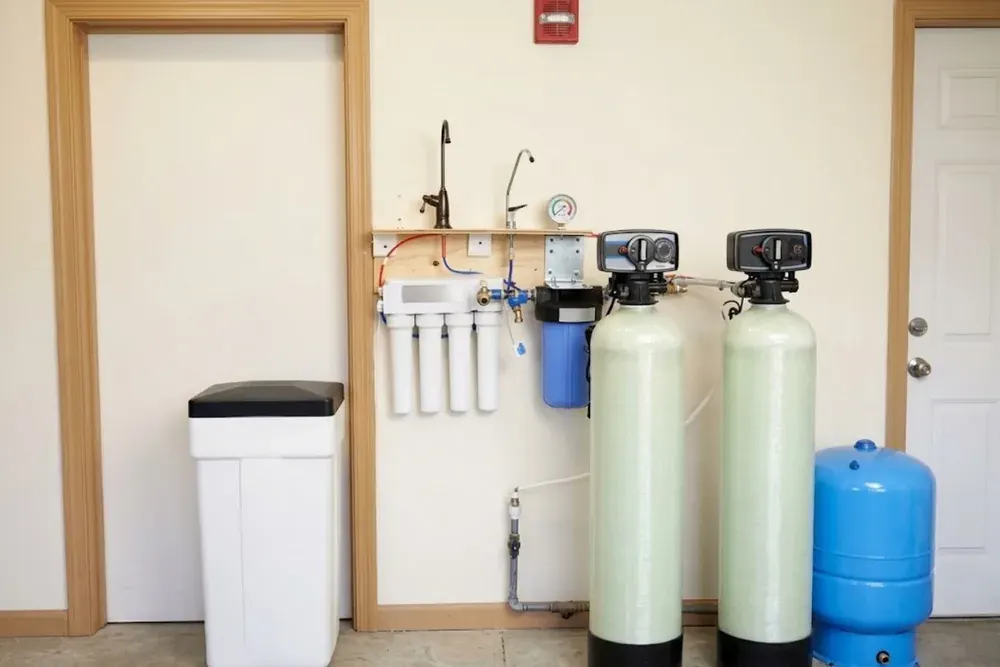
Softener, filter or both
These solve different problems.
| System | What it does | Does not do |
|---|---|---|
| Salt-based softener | Removes calcium and magnesium by ion exchange | Does not remove most contaminants |
| Whole-house filter | Reduces sediment, chlorine and taste issues, depending on media | Does not soften water |
| Reverse osmosis at the tap | Polishes drinking water at one faucet | Does not treat the whole house |
| Scale inhibitor | Changes scale formation without removing minerals | Not a true softener |
A water test and your goals decide the mix. See tankless water heater for why scale matters to some equipment.
Chloramine, taste and filtration choices
The district's water report lists chloramine as the disinfectant. Chloramine is more stable than chlorine and some carbon filters remove it less readily, so the filter media matters if taste is the concern. A plumber can match the media to your goal.
Padre Dam also notes that its water meets federal, state and local regulations. Filtration is a preference for taste or equipment protection, not a requirement.
Source: Padre Dam Municipal Water District, 2023 Water Quality Report and Water Quality page.
How a softener installation goes
Installation is a half-day to day project in most homes.
- 1
Test the water
Hardness is measured at the tap.
- 2
Size the unit
Capacity follows household size and hardness.
- 3
Plumb the unit
Bypass valves, a drain line and an overflow are installed.
- 4
Program and test
Regeneration is set and the system is verified.
Maintaining a softener
A salt-based softener needs regular salt and an occasional cleaning of the brine tank. Check the salt level monthly and keep it above the water line in the tank. If a hard crust forms on the salt, break it up so the system can dissolve it.
The control valve regenerates on a schedule set for your household and hardness. If the water turns hard again, check the salt, the bypass valve and the control settings before calling. A plumber can service the valve, replace resin when it wears out and check for leaks at the drain line.
Standards for treatment equipment
Softeners are tested to NSF/ANSI 44. Filters that reduce taste and odor are tested to NSF/ANSI 42, and filters that reduce health-related contaminants to NSF/ANSI 53. Reverse osmosis systems follow NSF/ANSI 58. Check the packaging for the standard that matches your goal.
Installation follows the California Plumbing Code, based on the Uniform Plumbing Code (UPC), which covers backflow protection and the air gap on a softener drain line.
What to do before a treatment install
Preparation helps the plumber size the system.
- Find your hardness numberYour water district report lists it, and a test kit confirms it.
- Pick the equipment spotA garage wall with power and a drain is ideal.
- Count the people in the houseHousehold size drives the capacity you need.
- Decide on drinking water polishAn under-sink unit may be enough on its own.
What affects the cost
Costs differ between systems.
Water softener and filtration questions
Padre Dam's 2023 report lists hardness by plant, from about 9 to 18 grains per gallon at two main plants. Your tap can vary, so test it.
If scale bothers you or you have a tankless heater, a softener can help. It is a convenience choice.
Yes. See water heater installation for planning both together.
It adds a small amount of sodium. Ask your doctor if you are on a restricted diet.
Yes. If a softener leaks or a drain overflows, call the 24/7 line.
Filters at the tap are a separate choice. Ask about the media for chloramine.