When a clogged drain is an emergency
A drain stops being a nuisance when water rises toward the rim and keeps rising. That is the moment to stop adding water and call. Our emergency line is open 24/7, including nights, weekends and holidays, and we book same-day visits when the schedule allows.
While you wait, shut off the faucet, skip the dishwasher and washing machine, and keep everyone from flushing. Every gallon you add has to go somewhere, and in a blocked line it goes back up the lowest opening. In most Santee houses that is the shower, tub or floor drain.
Signs the clog is in the main line, not one fixture
A clog in a single sink is usually a short fix. When several drains act up together, the blockage sits further down the line, and that changes the tools and the urgency.
Gurgling after a flush
Air is being pushed back through traps because the main line cannot clear it. Expect more than one fixture to be involved.
Tub fills when the washer drains
Water is finding the lowest opening it can reach. The blockage is past the point where those lines join.
Slow everywhere
If the kitchen, bath and laundry all drain slowly, treat it as one main-line problem, not three small ones.
Odor near the floor drain
A sewer smell with a slow drain points to standing water in the line and often to a partial blockage.
Why drains clog in Santee homes
Santee grew fast after the Carlton Company bought 4,300 acres of former ranch land in 1958. Its population climbed from under 2,000 in 1950 to 25,750 by 1970, which means a large share of the housing stock is now half a century old or more. Drain lines from that era can be rough inside, and grease and paper catch on the rough spots.
Hard water adds to it. Padre Dam Municipal Water District reports hardness of roughly 9 to 18 grains per gallon at the treatment plants it lists, depending on the plant. Hard water turns soap into curds that cling to pipe walls, so bathroom drains narrow slowly over the years. If your tub drains a little slower every season, that is usually the cause.
Which clearing method fits the clog
The right tool depends on where the blockage sits and what it is made of. A technician picks after listening to the symptoms and, when needed, looking inside the line.
| Method | Best for | What to know |
|---|---|---|
| Hand or machine snake | Single-fixture clogs, hair, paper, small grease plugs | Fastest option. Cuts through the clog and leaves a clear path. |
| Hydro jetting | Grease and scale coating the whole pipe wall | Water pressure scours the line. See hydro jetting for when it makes sense. |
| Camera inspection | Repeat clogs and unknown causes | Shows roots, breaks or bellies so the fix targets the cause. See sewer camera inspection. |
A line that clogs again within weeks is telling you something, and a camera usually finds it.
What a drain cleaning visit looks like
The visit follows the same order every time so nothing is guessed.
- 1
Describe the symptoms
Tell dispatch which fixtures are slow or backed up and when it started. That narrows the blockage to one branch or the main.
- 2
Locate the access point
The plumber finds the nearest cleanout or removes a trap and runs the cable in from the right spot.
- 3
Clear and test
The cable breaks up or retrieves the clog. Then water runs through every fixture on the line to confirm flow.
- 4
Explain what was found
You hear what the cable brought out and whether a camera check or jetting is worth doing next.
Before the plumber arrives
A few minutes of care keeps a small backup from becoming a flooded floor.
Stop the water
Turn off faucets and hold the laundry. Do not run the garbage disposal into a blocked line.
Skip the chemical openers
Liquid drain openers can sit in a standing pool and burn skin and finishes. They also make the plumber work around a caustic fluid.
Find the cleanout
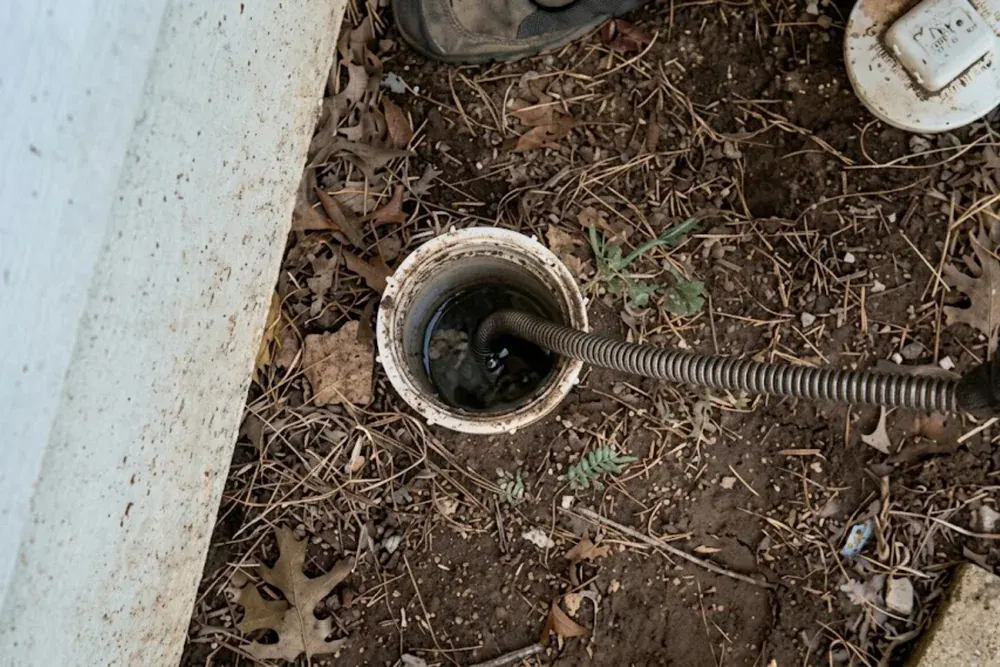
Many Santee homes have a capped cleanout outside near the foundation. Clear the area around it, but leave the cap on until the plumber arrives.
Protect the floor
Put towels at the lowest drain and move rugs and cardboard boxes away from it.
How the plumbing code shapes a drain call
The California Plumbing Code, based on the Uniform Plumbing Code (UPC), requires every trap to hold a water seal and expects cleanout access along drain lines. Those rules matter on a service call. A cleanout is the preferred way into a line, and a pulled toilet or an opened trap is the fallback.
If your house has no accessible cleanout, the plumber can often add one while the line is open. It makes every future cleaning cheaper and less messy.
What drives the price of drain cleaning
Drain work is priced by access and difficulty, not by a flat menu.
Drain cleaning questions from Santee homeowners
Yes. The line is open 24/7, including holidays. Describe what is backing up, and we send a licensed plumber as soon as one is free, with same-day visits when available.
We advise against it for a standing backup. The chemical sits in the water, can splash back on skin, and does not reach a deep clog. A cable removes the blockage instead of dissolving part of it.
Grease cools and hardens inside the pipe and traps food scraps. Cleaning it with a cable only opens a channel. Hydro jetting scours the walls and slows the return of the clog.
If only your house backs up, the blockage is in your line. If neighbors on the street back up too, call Padre Dam Municipal Water District, which handles wastewater collection in Santee.
Yes. Floor drains in garages and laundry rooms and exterior cleanouts are common access points. If the main line is involved, sewer line cleaning covers the full run to the street.
Not usually, if the cause was hair, paper or a one-time plug. A repeat clog points to grease, roots or a damaged section, and sewer line repair is the fix when the pipe itself has failed.