Sewer backup: what to do first
Sewage coming up through a floor drain or tub is a health issue as well as a plumbing one, and it gets worse with every flush. Call the 24/7 line now and we schedule a same-day visit when a technician is free. Meanwhile, stop all water use in the house, including the washer, and keep people and pets out of the affected room.
Wear rubber boots and gloves if you must walk through it, and do not run fans or touch outlets near standing water.
Stop every drain
No flushing, no showers, no laundry. All of it ends up in the same blocked line.
Keep away from wet outlets
If water reaches a plug or a power strip, leave it alone and switch off that circuit at the panel only if the panel is dry.
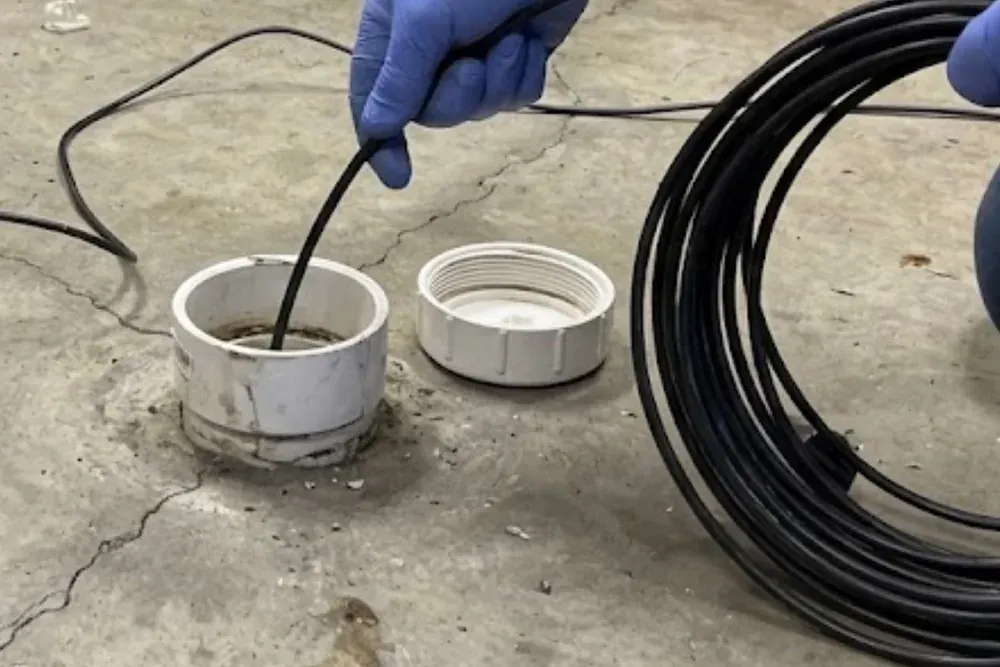
Open the cleanout cap carefully
Only if you can do it safely. A backed-up line can release pressure and spray, so stand to the side and tell the plumber you did it.
Take photos for your records
Pictures of the water level and affected items help if you later talk to your insurer or landlord.
What sewer line cleaning covers
The sewer line is the pipe that carries everything from your house to the connection with the district main. Cleaning it means running a heavy-duty cable or a jetting hose through the whole run, usually from a cleanout outside the home. A smaller sink cable cannot reach that far or cut through roots and packed paper.
It is a different job from ordinary drain cleaning. The cable is larger, the access is outdoors, and the result is verified with water flow from every fixture. When the cleaning finds a break or a bellied pipe, the next step is a camera, which is what sewer inspection covers.
Why Santee sewer lines back up
The causes are mostly local and mostly predictable. These are the four we see first.
Roots at the joints
Roots seek water and enter the line where joints open. A root mass catches paper and the line backs up slowly, then all at once.
Older pipe interiors
Cast iron and clay develop rough walls over decades. Grease and wipes snag on them. Santee's main growth came between the 1950s and 1970s, so many lines are at that age.
Flushed wipes
Wipes labeled flushable do not break down like paper. They collect at bends and form a plug.
Wet-weather loading
Heavy rain adds groundwater and runoff to the system. Padre Dam's own plan records the 2010 Sycamore Creek flooding that inundated its influent pump station.
How the symptoms point to the cause
The pattern of backups tells the plumber where to start.
| What you notice | Likely location | Next step |
|---|---|---|
| Lowest drain in the house backs up first | Main line, downstream of everything | Open the main cleanout and cable the line |
| Only the toilet gurgles | Branch line serving that bathroom | Clear the branch, check the vent |
| Neighbors report the same | District main in the street | Call Padre Dam Municipal Water District |
| Repeat backups every few months | Roots, belly or break | Camera inspection after cleaning |
A technician confirms the location on site before choosing the equipment.
How we clear a main sewer line
The work follows a fixed order so the result can be proven.
- 1
Find the cleanout
The plumber locates the outdoor cleanout, or pulls a toilet when there is none.
- 2
Run the cable
A machine cable with a cutting head breaks through the blockage and scrapes the pipe walls.
- 3
Flush and test
Water is run through the line to confirm a full, fast flow.
- 4
Recommend a camera if needed
Repeat blockages or odd findings lead to a camera check, and hydro jetting when grease or scale is the cause.
Why cleanouts and traps matter for sewer work
The California Plumbing Code, based on the Uniform Plumbing Code (UPC), expects cleanouts at the base of stacks and at the property line on many installations. A cleanout gives the plumber a straight path for the cable or the jetter, and it avoids pulling a toilet.
If a cleanout is buried, cracked or missing, ask about adding or raising one. A proper cleanout turns the next sewer service into a short visit.
What affects the cost of sewer line cleaning
The price depends on the line and the access, which are known only on site.
Sewer line cleaning questions
Yes. The line is staffed 24/7. We send a licensed plumber with main-line equipment as soon as one is free, and same-day visits are available when the schedule allows.
If the blockage is in your private lateral, it is the homeowner's to clear. If it is in the district main, Padre Dam Municipal Water District handles it. The plumber checks which one it is on arrival.
A plunger will not move a main-line blockage and can push sewage back out through the lowest drain. Stop using water and call instead.
If the line clogs more than once a year, or the cable pulled out roots or sand, a camera shows why. See sewer line repair for what happens when the pipe has failed.
Keep grease, wipes and paper towels out of drains, and have a repeat-blockage line scoped. Trees near the lateral are worth watching.
No. Cleaning removes what is in the pipe. A repair fixes the pipe. A camera tells you which one you need.