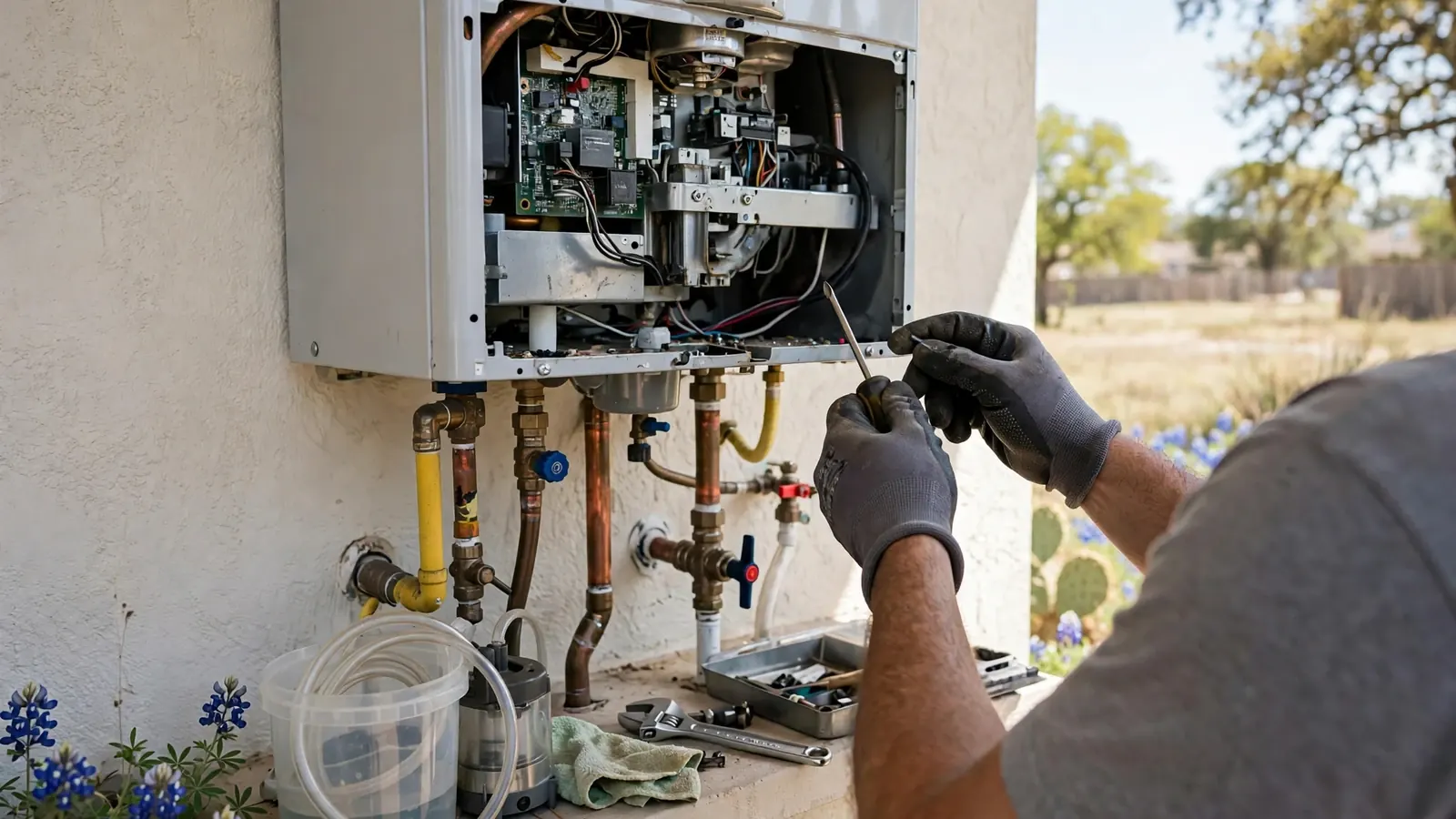
How a tankless heater works
A tankless heater fires a gas burner or an electric element only when water flows, then heats the water as it passes through a heat exchanger. There is no storage tank to keep hot, so the unit never runs out as long as demand stays within its rated flow. That is the main advantage over a tank.
The trade-offs are higher upfront cost, venting or electrical upgrades and regular descaling. See water heater installation for the full comparison with tank units.
Is tankless right for your home
The decision turns on four things.
Peak demand
Add up the flow of fixtures used at the same time. The unit must meet that flow at your incoming water temperature.
Fuel and venting
Gas models need proper venting and gas line size. Electric models need heavy circuits.
Space
Wall mounting frees floor area, but clearances still apply.
Water quality
Hard water scales the heat exchanger, so a flushing plan matters.
Hard water in Santee and what it does to a tankless heater
Padre Dam Municipal Water District's 2023 water quality report lists hardness of roughly 9 to 18 grains per gallon depending on the plant, which is firmly in the range where scale forms inside a heat exchanger. Scale narrows passages and lowers efficiency, and a unit can throw error codes.
The usual defense is an annual flush with a descaling solution, and some homes add a softener, see water softener and filtration. Check your manual for the flush schedule.
Source: Padre Dam Municipal Water District, 2023 Water Quality Report.
Services for tankless units
We handle the full life of the unit.
| Service | What it includes | When to book |
|---|---|---|
| Installation | Sizing, venting, gas and water connections, condensate, controls | Planned upgrade or tank replacement |
| Repair | Diagnose error codes, igniter, sensors, flow switch | No hot water, fault codes, cold sandwich |
| Flush and descale | Isolate and circulate a descaler through the heat exchanger | Yearly, or when flow drops |
If a tank unit has failed, see water heater replacement.
What a tankless flush involves
A flush is a short, straightforward visit.
- 1
Isolate the unit
The plumber closes the valves and connects a small pump and hoses.
- 2
Circulate descaler
The solution runs through the heat exchanger for the time the maker recommends.
- 3
Rinse and restore
The unit is flushed clean, filters are cleared and valves reopened.
- 4
Test
Flow and temperature are checked and fault codes cleared.
Tankless repairs we see most
Error codes are the usual signal. A code can point to a scaled heat exchanger, a failed flow sensor, an exhaust or vent problem, or an ignition fault. The plumber reads the code, checks the symptoms and tests the part before replacing anything.
Cold bursts in the middle of a shower often come from low flow rather than a failure. Aerators and showerheads clogged with scale can drop the flow below the unit's activation point. Cleaning them is a cheap first step before a service call.
If the unit is old and parts are scarce, we say so. A repair that costs most of a replacement is not good value, and we will show you both prices.
Manufacturer guidelines and code for tankless units
A tankless heater is installed to the maker's instructions and the California Plumbing Code, based on the Uniform Plumbing Code (UPC). Gas units need the right gas line size and approved venting. Condensing units need a condensate drain.
Following the maker's guidelines also protects the warranty. That includes the descaling schedule and the use of isolation valves for flushing.
What affects the cost of tankless work
Costs differ between install, repair and flush.
Tankless water heater questions
Most makers suggest yearly. In hard water, check it more often and watch for error codes.
The unit may be undersized, scaled or have a sensor fault. A technician tests flow and temperature.
Sometimes. Gas units often need different venting, so the plumber checks first.
We service common models. Call with the make and model and the dispatcher can confirm parts availability.
If it has failed, call the 24/7 line. See water heater repair for urgent diagnosis.
It can, because it has no standby loss. Actual savings depend on your usage and fuel prices.