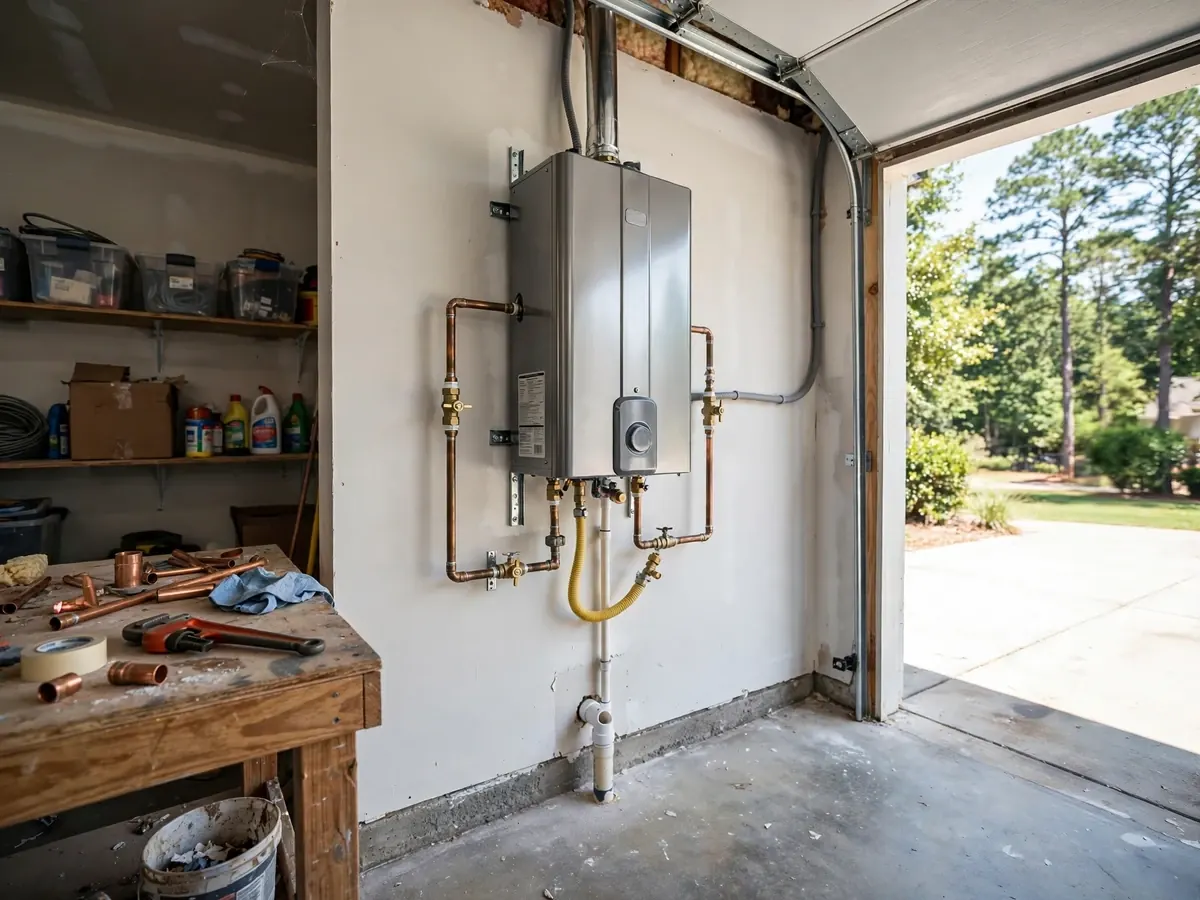
The short answer
Descaling a tankless heater means circulating a mild acid solution, usually white vinegar or a manufacturer-approved descaler, through the heat exchanger and then rinsing it clean. You isolate the unit with its service valves, connect a small pump and two hoses to the service ports, run the solution for the time the maker recommends and flush with clean water.
Plan on once a year in hard water, and more often if you see error codes, reduced flow or lukewarm water. Check your manual first, because the maker may require a specific solution and procedure to keep the warranty valid.
Tools and materials
You need a few simple items.
| Item | Purpose | Notes |
|---|---|---|
| Small submersible pump | Circulates the solution | Rated for the solution you use |
| Two hoses with fittings | Connect to the service ports | Match the port size |
| 5-gallon bucket | Holds the solution | Use a clean bucket |
| White vinegar or descaler | Dissolves scale | Follow the maker's guidance |
| Screwdriver or wrench | Open service valves and filters | As needed |
Read the manual for the correct solution and time.
The flush, step by step
The process takes about an hour.
- 1
Turn off power and gas
Switch off the unit and close the gas valve.
- 2
Close the service valves
Close the cold supply and hot outlet isolation valves.
- 3
Connect the hoses
Attach one hose to the cold service port and the other to the hot port, with both ends in the bucket.
- 4
Run the solution
Pump the solution through for the time in the manual, often forty-five minutes to an hour.
- 5
Rinse and restore
Drain the solution, flush with clean water, clean the inlet filter and reopen the valves.
Signs scale is already a problem
Do not wait for a failure.
- Error codesScale in the heat exchanger can trigger overheating or flow faults.
- Lukewarm waterReduced heat transfer means a cooler output.
- Lower flowScale narrows the passages.
- Noisy operationBoiling or rattling sounds from the unit.
- Clogged aeratorsScale elsewhere in the house suggests scale inside the unit.
Choosing a descaling solution
White vinegar is the common choice because it is cheap and widely available. Some makers sell their own descaler, and a few require it for warranty coverage. Read the manual or the data plate to see which applies to your unit.
Use enough solution to cover the pump intake and keep the hoses submerged. Avoid mixing products, and never use a solution that the maker lists as unsafe for the heat exchanger. If the manual is missing, the maker usually posts it online by model number.
Cleaning the inlet filter and checking the vent
While the unit is isolated, pull the small inlet filter screen and rinse it. A clogged screen cuts flow and mimics a scale problem. Look at the vent pipe and the intake for debris, loose joints or nests, and check that the condensate line drains freely on a condensing unit.
Write the date on a label near the unit and note the solution you used. A short log makes the next service easier and gives a technician useful history if you ever need help.
What a neglected unit looks like
A unit that has gone years without a flush can show persistent error codes, a high temperature rise that cannot be met and a pulse of cold water between hot cycles. Scale can also stress the pump and sensors.
Some neglected units recover after repeated flush cycles. Others have lost heat exchanger capacity for good. A plumber can tell the difference with a flow and temperature test, so you know whether to keep the unit or plan a replacement.
Following the maker's guidelines
The maker's guidelines decide which solution is allowed, how long to run it and how often to flush. Following them protects the warranty and the heat exchanger. The California Plumbing Code, based on the Uniform Plumbing Code (UPC), also requires service access around the unit and a proper vent.
Write down the date and the product you used. If a claim ever comes up, a record shows the unit was maintained.
Santee note: why hard water matters here
Padre Dam Municipal Water District's 2023 water quality report lists hardness at its treatment plants of roughly 150 to 316 parts per million at one and 165 to 291 at another, about 9 to 18 grains per gallon. At that level scale forms on any surface that heats the water, which includes a tankless heat exchanger.
A softener reduces scale and extends the time between flushes. See water softener and filtration for the options. The City of Santee does not list water heaters on its page about work not requiring a permit, so ask Planning and Building if you are changing the equipment.
Sources: Padre Dam Municipal Water District, 2023 Water Quality Report. City of Santee Planning and Building.
When to hand the job to a plumber
Gas and venting work should not be improvised. If the unit has an error you cannot clear, if the valves are seized or if you are not sure what solution the maker allows, call a plumber. A flush is a routine service for us, and we can combine it with a check of the vent, the gas pressure and the filter.
A neglected unit may need more than a flush. If scale has built up for years, the plumber may need repeated cycles or replacement parts. See tankless water heater service for how we handle that.
Tankless unit needs a flush?
Call the 24/7 line to book service.
Tankless descaling questions
Yearly is common advice. In hard water, check earlier if you see codes or lower flow.
Many makers allow white vinegar. Check your manual first.
Not if you follow the maker's method. Skipping it may affect coverage.
They make flushing much easier. A plumber can add them.
Yes. See our El Cajon page for coverage.