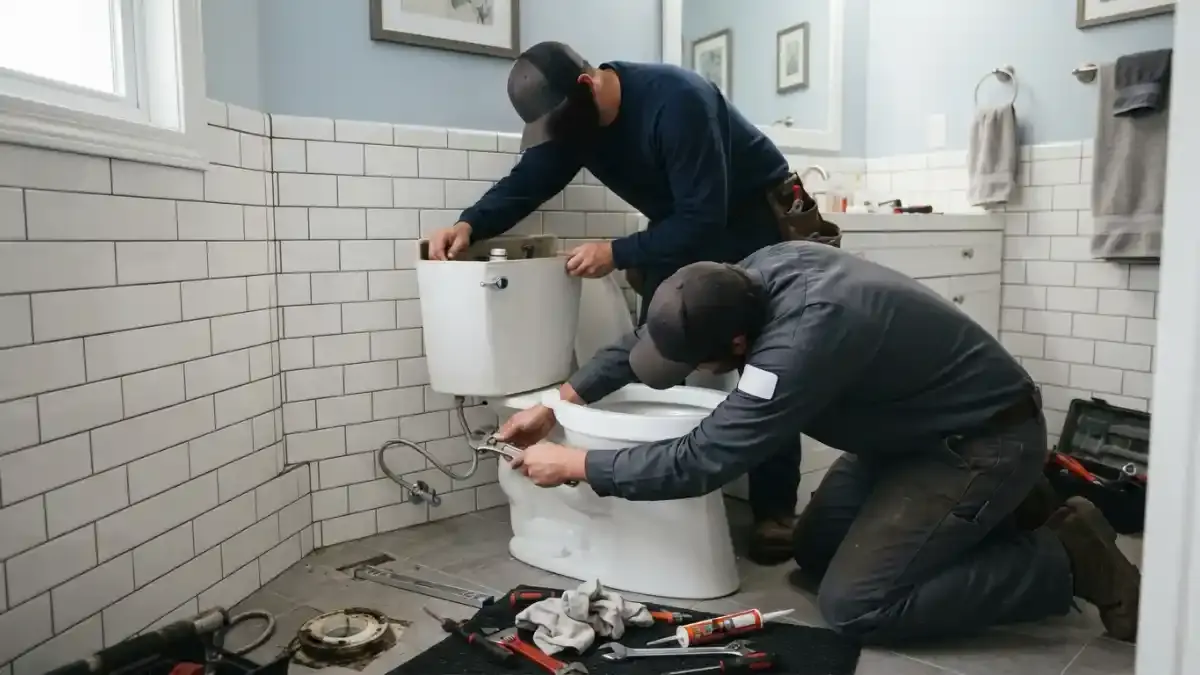
Overflowing toilet: what to do first
An overflowing toilet can soak a bathroom floor in minutes. Reach behind the toilet and turn the small supply valve clockwise to stop the refill, then lift the tank lid and hold the flapper down if water is still rising. Then call the 24/7 line, and we book same-day visits when a technician is free.
If the water is dark or smells of sewage, other drains may be backing up too, and the cause may be the main line.
Close the supply valve
The oval handle on the wall behind the toilet. Turn it clockwise until it stops.
Stop flushing
Each flush adds water to a bowl that has nowhere to go.
Protect the floor
Towels at the base buy time. Move rugs and mats out of the way.
Check other drains
If the tub gurgles or the sink backs up, call and mention it. See sewer line cleaning.
Common toilet problems and what they mean
Most toilet calls fall into a few categories.
- Constant runningA worn flapper or a fill valve that will not shut off wastes water all day.
- Weak flushMineral deposits under the rim holes or a low water level in the tank reduce flush power.
- Rocking toilet or leak at the baseA failed wax ring or a broken flange lets water escape and can rot the subfloor.
- Clog that a plunger cannot clearA deeper blockage needs a closet auger or a drain cable.
- Tank sweating or leakingA bad tank-to-bowl gasket or supply connection.
Hard water and toilet parts
Padre Dam Municipal Water District's 2023 water quality report lists hardness of roughly 9 to 18 grains per gallon, depending on the plant. Mineral buildup clogs the rim jets of toilets and stiffens the rubber parts inside the tank, so flappers and fill valves in the area tend to age quickly.
A vinegar soak helps with minor rim deposits, but heavy buildup needs a descaler or a part swap. A plumber can tell which in a minute.
Source: Padre Dam Municipal Water District, 2023 Water Quality Report.
Repair, reseat or replace
The right fix depends on the cause and the age.
| Problem | Usual fix | When to replace the toilet |
|---|---|---|
| Running toilet | New flapper or fill valve | Cracked tank or bowl |
| Leak at the base | Replace the wax ring, check the flange | Damaged flange cannot be repaired |
| Repeated clogs | Auger the trap, check venting | Old low-flow model that never flushes well |
| Cracked porcelain | None | Always |
A running or dripping sink faucet is a different repair, covered at faucet repair.
Flow limits and standards on toilets
New toilets sold in California are limited to 1.28 gallons per flush, and many are certified under the EPA WaterSense program. The California Plumbing Code, based on the Uniform Plumbing Code (UPC), also sets rules for the flange, the supply connection and the venting behind a toilet.
If a repair keeps failing on an older high-volume toilet, a WaterSense model may save water and end the repeat visits.
What affects the cost of toilet repair
Repairs are quick, installs vary by toilet.
Toilet repair questions
Yes. The 24/7 line stays open. We send a licensed plumber as soon as one is available, with same-day visits when possible.
Usually a worn flapper lets water leak into the bowl. The tank then refills in short cycles.
Tank repairs usually can. Leaks at the base and flange problems need the toilet lifted.
If it clogs often or wastes water, a modern one may be smarter. See plumbing installation for fixtures.
The City of Santee says removing and reinstalling a water closet is exempt when it does not involve replacing or rearranging valves, pipes or fixtures. Ask Planning and Building about your job.
That suggests the main line. See drain cleaning.