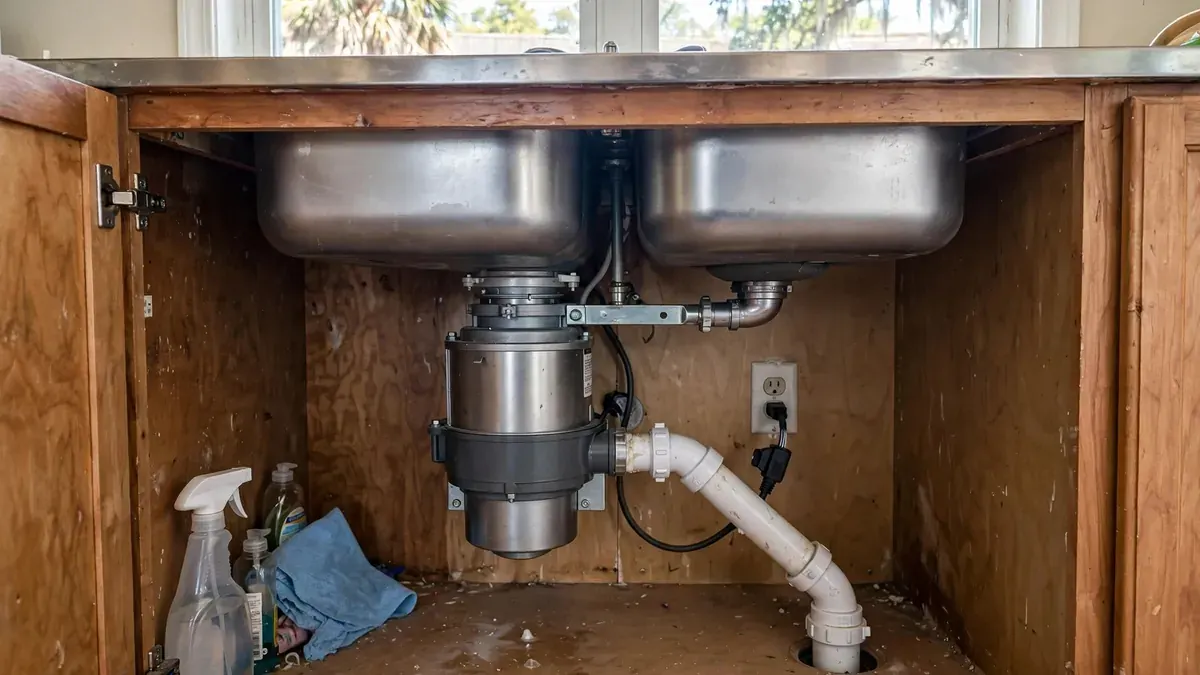
When a disposal fails mid-dinner
A disposal that stops with a sink full of water is a real problem, especially on a holiday. Switch it off, never put a hand inside, and call the 24/7 line. We book same-day visits when a technician is free.
If the unit hums but does not turn, it is jammed. If water pours from the base, it is leaking. Either way, shut off the power switch and leave the unit alone until the plumber arrives.
Common disposal problems
Disposals fail in a few predictable ways.
- Humming but not spinningA jam. The plumber frees the flywheel with the hex key at the bottom.
- Silent, no humA tripped reset button, dead outlet or burned motor.
- Leaks at the topA failed flange seal or loose mounting ring.
- Leaks at the sideA cracked housing or loose drain connection.
- Slow drain with the disposalThe disposal outlet or the line past it is clogged.
What clogs disposals and what does not
Grease, fibrous peels, coffee grounds and starchy food like pasta and rice cause most clogs. Hot grease flows at first and hardens farther down the line. A disposal grinds food small, but it does not make grease disappear.
Keep fats in a can for the trash and run cold water while grinding. If the kitchen sink keeps backing up, the clog may be past the disposal, and drain cleaning reaches the line behind it.
Repair or replace the disposal
The decision depends on the failure.
| Problem | Fix | Replace when |
|---|---|---|
| Jam | Free with the hex key, reset | Repeated jams |
| Leak at the flange | Reseat and re-seal | Housing cracked |
| Leak from the base | None | Always, the housing has failed |
| Motor burned out | None | Always |
See faucet repair if the leak is from the faucet or supply lines above the cabinet.
What happens on a disposal visit
The goal is a working unit and a clear drain.
- 1
Check power and reset
The plumber checks the switch, outlet and reset button.
- 2
Free or inspect
The blades are freed, and the unit is checked for leaks.
- 3
Clear the drain
The drain trap and line are checked for a clog.
- 4
Replace if needed
A matching unit is installed, with a new gasket and connections.
Choosing and installing a new disposal
Disposals are sold by motor size. A smaller motor suits a light-use kitchen. A larger motor with more grinding stages handles tougher scraps and runs quieter. Pick one that fits the cabinet, because tall units can crowd the trap and the pipes behind them.
A proper installation sets the mounting ring, connects the drain trap with the right slope and joins the dishwasher drain through the knockout plug in the disposal. The plumber also checks that the electrical supply is a safe, grounded outlet or a hardwired connection. A new disposal should run without leaking when water is on and the unit is grinding.
Cold water while grinding keeps fats solid so they flush through. Citrus peels are fine in small amounts, but fibrous items such as celery, corn husks and artichoke leaves wrap around blades and slow the motor.
What affects the cost of disposal work
Repair and replacement are priced differently.
Garbage disposal questions
Yes. The 24/7 line is open. We send a licensed plumber as soon as one is free, with same-day visits when possible.
No. Always cut power first and use the hex key at the bottom or a wooden spoon handle from above.
A leak at the flange or a connection can be fixed. A leak from the body means replacement.
No. Grease cools and sticks inside the drain line. Put it in the trash.
Yes. We also reconnect the dishwasher drain.
The clog may be in the line behind it. See sewer line cleaning if multiple drains are slow.