The short answer
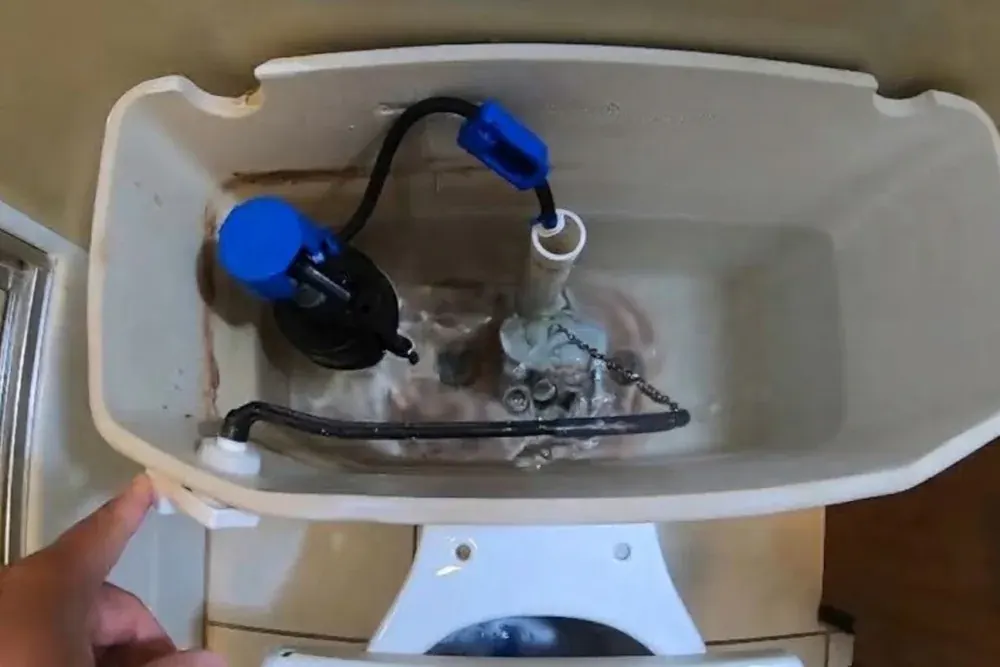
A flush lever that feels loose, will not return or does not flush has one of four problems: a loose mounting nut, a chain that is too long or too short, a bent or broken arm or a worn handle. Remove the tank lid, watch what happens when you press the lever and tighten, adjust or replace the part that is not moving as it should.
The job takes minutes and most replacement handles cost little. Turn the water off at the toilet first if you plan to open the tank for more than a look, and keep a towel handy.
Diagnose the lever
Work through these checks in order.
- 1
Remove the lid
Lift it straight up and set it on a towel.
- 2
Press the handle
Watch the arm inside lift the chain.
- 3
Check the chain
It should have about half an inch of slack when the flapper is closed. Too much slack leaves the flapper down. Too little keeps it from sealing.
- 4
Check the nut
The mounting nut holds the handle to the tank. It has a reverse thread, so turn it clockwise to loosen it.
- 5
Inspect the arm and handle
Look for bends, cracks and corrosion.
Symptom, cause and fix
Most lever problems are cheap to fix.
| Symptom | Likely cause | Fix |
|---|---|---|
| Handle loose and floppy | Loose mounting nut | Tighten the nut, remember the reverse thread |
| Handle sticks down | Corroded arm or bent handle | Replace the handle assembly |
| Need to hold the handle | Chain too long or flapper worn | Shorten the chain or replace the flapper |
| Toilet runs after flushing | Chain tangled or too short | Adjust the chain length |
| Handle snaps off | Worn plastic | Replace the handle |
A running toilet may need a new flapper or fill valve. See toilet repair for those fixes.
Replacing the handle
Buy a handle that matches the mounting position, front, side or angle, and the finish you want. Unscrew the old nut, pull the handle out, thread the new one through and tighten the nut by hand plus a quarter turn. Attach the chain to the arm and set the slack.
Test several flushes. The handle should move smoothly and return on its own. If it does not, the arm may be rubbing the tank wall or the lid, so reposition it. Take care not to overtighten, since porcelain can crack.
Signs the problem is bigger than the lever
If these show up, look beyond the handle.
- Water leaks at the baseA wax ring or flange problem.
- The toilet keeps cloggingA trap or line problem. See drain cleaning.
- Cracked tank or bowlReplacement is the only fix.
- Constant hissingA failing fill valve, which is also a cheap part.
Choosing the right replacement handle
Handles come in front-mount, side-mount and angled styles, so note where the old one sits before you shop. Check the finish too. Chrome, brushed nickel and white are common, and a metal handle outlasts plastic in a busy bathroom.
Take the old handle to the store or photograph the tank and the arm. A universal kit usually includes several arm lengths and a nut that fits most tanks, so one purchase covers most toilets.
Dual flush and push button tanks
Some tanks use a push button on top, and the repair is different. The button connects to a rod or cable that lifts the flush valve. If the button feels loose or fails to return, the cause is usually the linkage or the mounting ring under the lid.
Dual flush tanks add a second mechanism for the half flush. They are well made, but parts are specific to the model. Look for a brand and model number inside the tank, and order the exact kit from the maker.
Stopping the next failure
A quick check once a year keeps small problems from growing. Lift the lid, flush and watch the chain, the flapper and the fill valve. Look for crusty deposits on metal parts and replace anything that looks worn.
If the toilet runs, hisses or flushes weakly after you fix the handle, the next part in line is the flapper or the fill valve. Both are inexpensive and quick to swap, and a plumber can do both during a single visit.
Flush volume standards
New toilets sold in California are limited to 1.28 gallons per flush, and many carry the EPA WaterSense label. The California Plumbing Code, based on the Uniform Plumbing Code (UPC), sets the rules for installing the fixture.
A handle repair does not change flush volume, but a worn flapper or fill valve can. If the toilet wastes water, those parts are the next place to look.
Santee note: hard water and permits
Padre Dam Municipal Water District's 2023 report reports a hardness range near 9 to 18 grains per gallon, set by the plant. Mineral deposits corrode chains, arms and mounting parts and stiffen rubber seals, so tank parts in the area wear faster than the packaging suggests. A look inside the tank once a year is a good habit.
The City of Santee's page on work not requiring a permit says fixing leaks in fixtures and removing and reinstalling a toilet are exempt when no valves, pipes or fixtures are replaced or rearranged. A handle swap is far smaller than that, so no permit question arises.
Sources: Padre Dam Municipal Water District, 2023 Water Quality Report. City of Santee, Work Not Requiring a Building Permit.
Toilet acting up?
Call the 24/7 line for toilet help.
Flush lever questions
The mounting nut is probably loose. Tighten it clockwise, since it has a reverse thread.
About half an inch of slack when the flapper is closed.
Usually yes, since the handle is above the water line. Turn off the supply if you plan to work inside the tank.
Rarely. A toilet that will not stop running or is overflowing is the emergency.
Yes. See our El Cajon page for details.