The short answer
Book a sewer camera inspection when a drain backs up more than once, when you are buying an older home, when you are planning a remodel or landscaping, or when you smell sewer gas outdoors. A camera shows roots, cracks, offsets and low spots, and it gives you footage to compare with quotes.
It costs less than most repairs and often prevents a wrong one. Cleaning a line again and again without a look is guessing, and a camera replaces the guess with evidence.
Five reasons to scope the line
Each reason changes what you do next.
Repeat clogs
Two backups in a year suggest a defect, not bad luck.
Home purchase
A pre-purchase scope shows what an inspector cannot see.
Remodel or addition
New fixtures add load. Know the line first.
Roots and trees
Roots enter at joints. A camera shows where and how bad.
After a repair
A post-work scope proves the repair is sound.
What the footage shows
Each finding points to an action.
| Finding | Meaning | Action |
|---|---|---|
| Root hairs at joints | Early intrusion | Clean and monitor |
| Cracked pipe | Leak and root entry | Spot repair or lining |
| Offset joint | Misaligned pipe that catches debris | Repair or replace section |
| Belly | Low spot that holds water | Replace section |
| Scale and grease | Narrowed bore | Jetting or scheduled cleaning |
| Collapse | Failed pipe | Replacement |
See sewer inspection for the process and sewer line repair for next steps.
What happens during a scope
It takes a short visit.
- 1
Find the cleanout
An outdoor cleanout is best. Without one, a toilet is pulled.
- 2
Run the camera
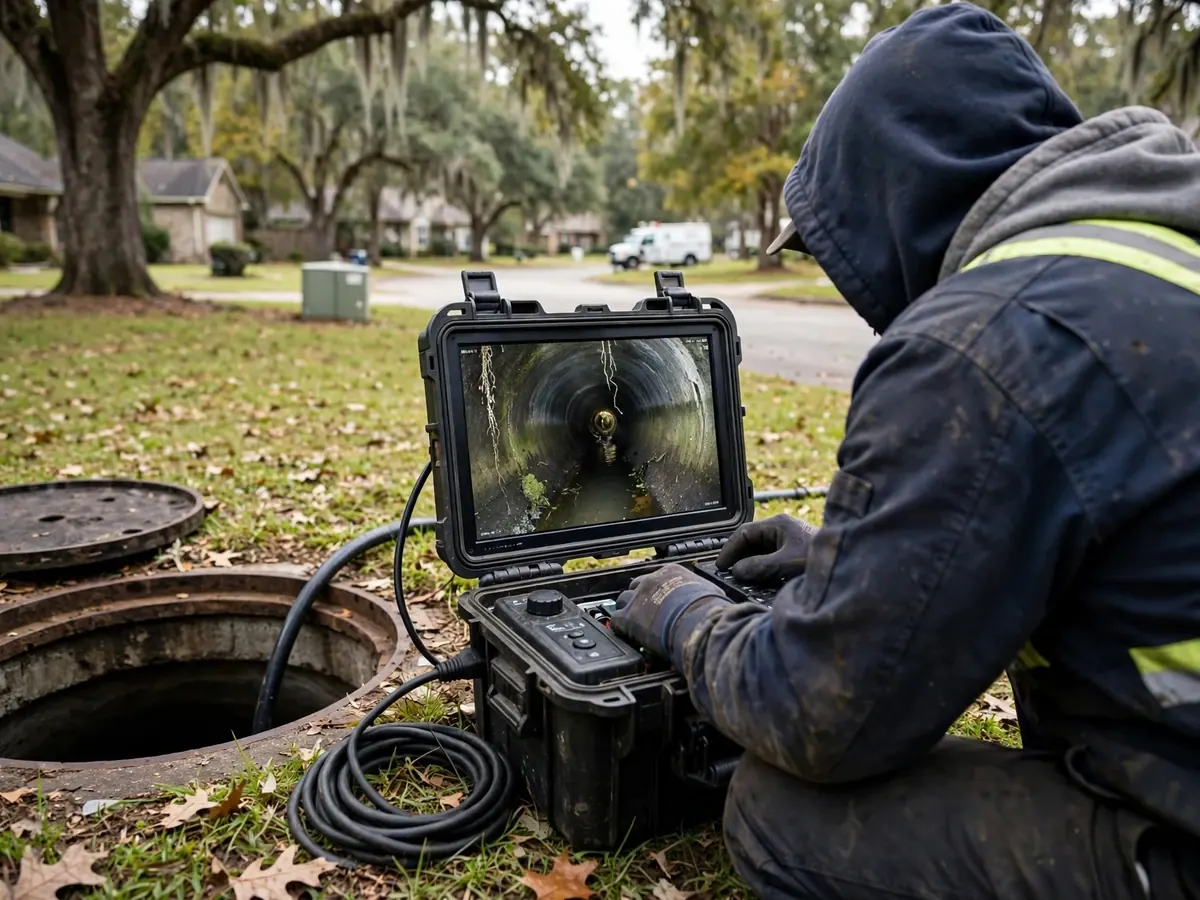
The cable feeds in while the monitor shows the pipe.
- 3
Note the distance
Defects are recorded by feet from the cleanout.
- 4
Review the recording
You see the footage and keep a copy.
Buying an older house
A pre-purchase scope is one of the best uses of the camera. The inspection report covers what is above ground, and the sewer lateral is buried. A bad line can mean a large repair soon after you move in.
Schedule the scope early in the contingency period. If the footage shows damage, you have facts for negotiating a repair credit or a price change. If the line is clean, you have a baseline for the future.
What a good inspection report includes
The footage is the core of the report, but notes make it useful. A good report lists the cleanout location, the pipe material where it can be seen, each defect with its distance from the cleanout and a short description of what it means for the line.
Ask for a copy of the recording and the notes. If you are buying a house, send them to your agent. If you are repairing a line, send them to any contractor who quotes the work, so every quote starts from the same facts.
If the camera cannot pass
Sometimes the camera stops before the end of the run. A heavy blockage, a collapsed section, a sharp offset or a belly full of sediment can all halt it. The distance on the cable counter tells where it stopped, which is the first clue.
The plumber then cleans the line and tries again, or probes from the opposite end if there is a second access point. A line that blocks the camera repeatedly in the same place likely needs repair at that spot.
Roots, offsets and what they mean for you
Roots enter at joints and cracks, and they keep growing as long as water and nutrients flow. Cutting them clears the line for a time, but the entry point remains. If the footage shows roots at several joints, planned cleaning or a lining may cost less than a series of emergency calls.
Offsets happen when the soil shifts and two pipe sections no longer line up. Paper and grease catch on the edge and grow into a plug. An offset usually needs a spot repair, and the camera shows exactly where to dig. See sewer line repair for the options.
Standards and records for a camera inspection
A camera inspection is a visual record. The California Plumbing Code, based on the Uniform Plumbing Code (UPC), sets slope and material rules that the video can be compared against, and the plumber notes distances to each finding.
Ask for the video and a short written summary. Home buyers often share them with sellers or inspectors.
What to do before the camera goes in
Good prep gets clean footage.
- Locate the cleanoutClear the area so the plumber can reach it.
- Stop using waterAvoid flushing or running fixtures right before the visit.
- Share the historyPast clogs, repairs and tree work near the line all help.
- Ask for the recordingYou should be able to keep the video and the notes.
Santee note: your lateral and the district main
Padre Dam Municipal Water District handles wastewater collection for Santee and maintains about 169 miles of wastewater mains across its service area. The camera covers your private lateral, from the house to the connection. If the footage shows a defect in the main beyond that, the plumber points you to the district.
The district's hazard plan records heavy rain in 2010 that flooded Sycamore Creek and inundated its influent pump station. Heavy rain adds load to the whole system, so a line already near its limit is more likely to back up in a storm. That is a good reason to scope a line with a history.
Source: Padre Dam Municipal Water District hazard mitigation annex (San Diego County, 2023).
Ready to see inside your line?
Call the 24/7 line to book a camera inspection.
Sewer camera questions
Most standard residential lines take under an hour. Cleaning first adds time.
No. The cable is flexible and the head is built for pipe interiors.
Yes. You keep the recording and notes.
It is less urgent, but still useful as a baseline after construction.
Yes. See our El Cajon page for coverage.